Source: Arandela Asociación Cultural. Sanxenxo
Source: Arandela Asociación Cultural. Sanxenxo
(Cantares Gallegos, 1863)
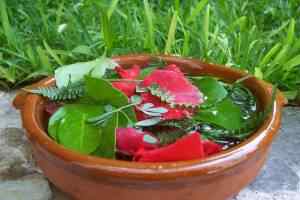
"Vinte unha crara noite" twice mentions a Galician tradition associated with the night of St. John's Eve (1.1.1-4, 2.2.1-4). This custom was the soaking of a bundle of medicinal and aromatic herbs in a bowl or in large tin basin under the moonlight of the summer solstice. Next morning everybody washed their face, hands or body with the fragrant, greenish water, and the bundle was put out to dry in the summer sun during several days. Once dry the bundle was hung from the back of the front door of the house and the herbs were used as the need arose. According to tradition this ritual exorcized evil spirits, warded off witches and protected against envy.
"Vinte unha crara noite" makes frequent use of the affectionate diminutive form (feminine termination iña, masculine iño). This form complicates the job of translating because an affectionate diminutive does not usually have a unique English equivalent and sometimes not even a single interpretation. Nevertheless to yield to the temptation of treating the affectionate diminutive as a nuisance and ignoring it altogether deprives the poem of its full expressiveness. On the plus side the affectionate diminutive offers the translator an opportunity to add alliteration, internal rhyme and lyrical sharpness to the text. The objective is to find the best adjective, adverb or noun which conveys smallness, frailty, concern or affection depending on the context.
All the words in "Vinte unha crara noite" that end in iña or iño are listed below together with a short explanation of the translation made.
na fonte a serenar (1.1.4, 2.2.4). "Fonte" means "fountain" but can also mean "table bowl."
Pombal (2.4.6). De Castro probably had Pombal de Abaixo in mind, 3.5 kilometers northeast of Padrón.1
|
I
Vinte unha crara noite,
Por eso, namorado,
As estrelliñas todas
Pero dempois con outros
Por eso eu che cantaba II
¡Que triste ora te vexo!...
Xa non te vin, meniña,
Ora, de dor ferida,
Mais anque dir, eu diga,
que donde moitos cospen, |
I
I saw you on a cloudless night,
That is why, enamoured,
All the twinkling stars
Yet afterward with others
That is why I used to sing to you II
How sad I see you now!...
No longer did I see you, lass,
Now you go about scarred by pain
But however much I say and say
That where many spit, |