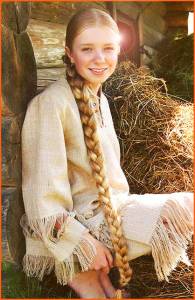
Source: saboteur365 blog. April 3, 2014
Source: saboteur365 blog. April 3, 2014
To Mr. Camilo Álvarez e Castro, Cantor of the Cathedral of Salamanca
(Ao Sr. D. Camilo Álvarez e Castro, Chantre da Catedral de Salamanca)
(Cantares Gallegos, 1863)
"Roxiña cal sol dourado" is related to "Lass of the Green Mountain" (poem 6).
De Castro dedicated "Roxiña cal sol dourado" to the cantor of the cathedral of Salamanca, Camilo Álvarez de Castro. This man was the only favourable critic of Cantares Gallegos. He wrote a letter to Rosalía de Castro, dated November 12, 1864, which was "full of affection and praise for the Galician poetess." He wrote his letter in the Galician language, a very unusual thing to do at the time,
What songs, Rosalía! See, I turn them over and over as is done to flour in the sieve, and I dare not touch them, for they are carnations and would wither and lose their aroma should I touch them. After these Cantares of yours I consider you a meiga (N.T. a good witch, a wizardess) [...] and be neither sated nor silent until everybody shouts, "Maybe it's true what this wizardess says about the treasures of Galicia!"
De Castro's books of poetry succeeded in making Galicians wish to rescue their language from oblivion. As the letter explained,
I arrived to the banks of the Tormes (N.T. the river that skirts the Castilian city of Salamanca) but I did not forget the Miño (N.T. the main river of Galicia). Nor did I forget the language of my parents and grandparents telling me stories in the kitchen, watching sparks dart and the dough boil in the hearth and cinders fly upward like snowflurries to the trammel chain by the light of the oil lamp [...] That is why I read your Cantares as a hungry man eats bread, as the butterflies kiss the flowers.
Some verses of "Roxiña cal sol dourado" are reverse sentences (1.1.5-7, 1.2.6-7, 1.4.5-7, 2.2.3-4, 2.5.3-4). Such sentences sacrifice logical sequencing in order to obtain rhyme or to proffer a deliberately prolix style. For example the translated sentence, "So white (her feet) they resembled two snowflakes in repose dazzling in the light of day" (1.5-7) reads in the original, "A snowflake in repose dazzling in the light of day her foot so white resembled." Reverse sentences often translate poorly into English without being rearranged.
"Roxiña cal sol dourado" is another poem of "Cantares Gallegos" that employs the affectionate diminutive form peculiar to the Galician language. The affectionate diminutive ends in iña (singular feminine) or iño (singular masculine). It makes translating harder and something of artwork, but to yield to the temptation of ignoring it altogether is to deprive the reader of the full emotion stamped on the poem.
All the words in "Roxiña cal sol dourado" which end in iña or iño are listed below together with a range of possible translations and a short explanation of the choice made where necessary. On the plus side, Galician affectionate diminutives provide the translator with an opportunity to add alliteration, internal rhyme or lyrical sharpness to the text. The goal of the translator is to find the best adjective, adverb or noun which conveys size, frailty, sympathy or endearment depending on the context.
co branco pé descalzado (1.1.4). The literal translation, "with the white foot unshod," is ambiguous in the English language, the girl is neither lame nor do her feet differ in colour, hence the better translation is, "with her white feet unshod." In tandem the translation turns De Castro's "copo de neve pousado" (1.1.5) into "two fallen snowflakes" (1.1.6).
cimbréase con folgura (1.4.6). De Castro uses the present tense ("sways") where the narrative's flow requires the past tense ("swayed"). The translation opts for the past tense.
cántanlle o doce a... la... lala (2.2.6). An alalá is a distinct type of traditional song. Alalá do Ulla is one example.
Five examples of traditional highland music follow. Xabier Díaz and Adufeiras de Salitre perform "Mountain Song" (first entry). The second and third entries are exhibitions of dance and music from the highlands of Ancares (Lugo province) and O Courel (Ourense province).
Xabier Díaz and Adufeiras de Salitre
Dance from the Courel Highlands (July 27, 2015)
|
I
Roxiña cal sol dourado,
As longas trenzas caídas,
Tiñan os cores do mare
Levaba na frente a ialma,
Ó par da brisa temprada II
Franca, pura, sin enganos,
Xunto dela os paxariños
Ela honesta está escoitando,
Dempois no rego que pasa
Compañeiras van chegando,
As estrelas van fuxindo,
Arredor todo arrescende
Danlle estrañeza os cantares,
Paxariños, verde prado,
Por eso a meniña hermosa,
I ela, que de tal se estraña, |
I
Pretty and blonde as the golden sun,
Long braids trailing down,
Her lovely sleepy eyes
She bore the soul on the brow,
She covered running, II
Sincere, pure, without duplicity,
Next to her the little birds
She is listening honest,
Afterwards on the passing creek
Companions start arriving,
The stars start departing,
Everywhere the scent of spring
She finds the songs strange,
Little birds, green meadow,
That is why the gorgeous girl
And she, who wonders at it, |