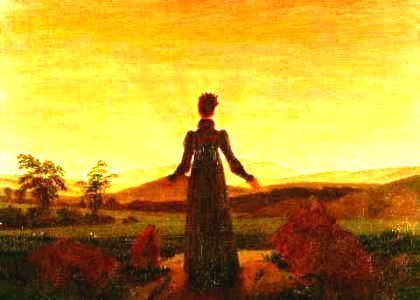
Caspar David Friedrich
Caspar David Friedrich
(Cantares Gallegos, 1863)
All the preceding poems have made extensive use of the affectionate diminutive form peculiar to the Galician language. "Alborada" is no exception. The affectionate diminutive ends in iña (singular feminine) or iño (singular masculine). Preceding poems have already shown that some words which end in iña or iño are not affectionate diminutives.
All the words in "Alborada" that end in iña or iño are listed below together with a range of possible translations and a short explanation of the term chosen. Galician affectionate diminutives let the translator add alliteration, internal rhyme and lyrical sharpness to the text. The goal of the exercise is to select the best adjective, adverb or noun which expresses affection, concern, frailty or smallness depending on the context. This selection becomes a personal choice when there is more than one translation available as it often occurs. Occasionally it is even advisable to ignore an affectionate diminutive because the context is unclear, because the extra term crimps the fluidity of the translated poem or makes the text unadvisedly cloy. The exercise can be tedious, challenging and time-consuming, but to sideline the affectionate diminutive altogether in the translation of "Cantares Gallegos" is to deprive the English reader of an approximation to what De Castro dubbed "those tender words and those idioms never forgotten which sounded so sweet to my ears since the cradle and which were gathered up by my heart as its own heritage."
atruxaremos, cantaremos o alalá! (last line). "Atruxar" is the blend of a yodel and a prolonged yell. Examples: Minutes 0:28-0:31 (somewhat muted) and 2:22-2:27 of this recording. An alalá is a traditional Galician song of remote origin; some researchers trace it back to the Gregorian chant.1 Alalá das Mariñas is an example.
De Castro molded the meter of "Alborada" on this morning song of Ourense which a neighbourhood piper used to play. The resultant lyrics and tune became known as the "Alborada de Rosalía de Castro" (Morning Song of Rosalía de Castro).
As part of the commemoration of the 150th anniversary of the publication of "Cantares Gallegos" Daniel Bellón plays the "Alborada de Rosalía de Castro" on the bagpipe (first entry). As part of the same commemoration Lucía Pérez and Rosa Cedrón gave a youthful interpretation of the "Alborada" on Radio Televisión Galicia (second entry). In 2008 Abe Rábade arranged a jazz vocal together with Guadí Galego and Anxo Angueira (third entry). Mary C. Otero Rolle wrote her own musical adaptation of the poem (fifth entry). Peque Coro Do Xan Viaño sings two stanzas (1.3, 2.2.1-4) with a distinct melody (sixth entry).
Daniel Bellón (February 24, 2013)
Lucía Pérez and Rosa Cedrón (February 22, 2013)
Guadí Galego, Anxo Angueira and Abe Rábade from the 2008 album Rosalía 21 (jazz)
Moncho do Orzán and Ricardo Morente (accordion and violin)
On February 24, 2013, the Rosalía de Castro Foundation, the Royal Galician Academy, the University of Vigo and the Galician Bagpipers Association invited pipers to play the "Alborada de Rosalía de Castro" in unison across Galicia to commemorate the 150th anniversary of the publication of "Cantares Gallegos." A short sample of localities and performances of the morning song is given next,
A Coruña, at the site of Sir John Moore's cenotaph
Allariz (Ourense)
Ordes (A Coruña)
Pico Sacro, at an altitude of 530 meters (Lestedo-Boqueixón, A Coruña)
Santiago de Compostela, before De Castro's tomb in the Pantheon of Illustrious Galicians
Villafranca del Bierzo (León)
|
I
¡Vaite noite, vai fuxindo!
¡Canta, paxariño, canta
Canta, paxariño alegre, canta. II
Noite escura logo ven moito dura
Que a auroriña o ceu colora
¡Sal! Señora en todo mal,
Branca aurora, ven chegando
Cor de alba hermosa III
Cantor dos aires, paxariño alegre,
Se espricando que te esprica,
¡Arriba todas, rapaciñas do lugar, |
I
Depart, night, start fleeing!
Sing, little bird, sing
Sing, merry little bird, sing. II
The dark night on its shift comes severe
For the darling dawn enamours
Leave, mistress of every evil! For the sun
White aurora, start arriving
Dawn's gorgeous colour III
Minstrel of the air, jolly little bird,
He chimes, he chimes,
Rise, lassies of the place, every one, |