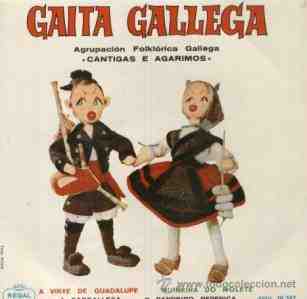
Vintage record cover from 1964

Source: Todo Colección


7.   Lure of the Piper     (Un repoludo gaiteiro)

(Cantares Gallegos, 1863)


Translator's Notes

"Un repoludo gaiteiro" makes modest use of the affectionate diminutive form peculiar to the Galician language. The affectionate diminutive ends in iña (singular feminine) or iño (singular masculine) but not every word that ends in iña or iño is an affectionate diminutive.

All the words in "Un repoludo gaiteiro" which end in iña or iño are listed below together with a range of possible translations and a short explanation of the choice made. Galician affectionate diminutives provide the translator with an opportunity to add alliteration, internal rhyme or lyrical sharpness to the text. The aim is to find the best adjective, adverb or noun which conveys size, frailty, sympathy or endearment as dictated by the context.


Explanation of some words, terms or expressions

de pano sedán vestido (1.2). Sedan is a French town of 20,000 inhabitants situated on the banks of the river Meuse in the Ardennes. The town became a major textile center between 1641 and the First World War and gave its name first to a glossy figure eight needlepoint and later to the manufacture of woolen rugs, carpets and cloth. Thus "cloth of Sedan" may describe a garment imported from Sedan or a local cloth stitched with the Sedan needlepoint.

Camiño da romería (7.1). A traditional romería is a festive picnic near a chapel or monastery on the holiday of its namesake (example from Brazil).

¡Canta risa nas fiadas! (11.2). A fiada was a gathering of women in the evening to make yarn in a festive atmosphere of storytelling, games and song.

non veñan ó meu tocar (12.2). Double entendre. Tocar can mean to play a musical instrument or to touch.


Musical Adaptation

The Orfeón Mariñeiro do Berbés (Sailors' Orpheon from the Berbés quarter of Vigo) covers Amancio Prada's adaptation below.

Orfeón Mariñeiro do Berbés (min. 3:20-7:25)


Un repoludo gaiteiro
de pano sedán vestido,
como un príncipe cumprido,
cariñoso e falangueiro,
antre os mozos o pirmeiro
e nas siudades sin par,
tiña costume en cantar
aló pola mañanciña:

Con esta miña gaitiña
ás nenas hei de engañar
.

Sempre pola vila entraba
con aquel de señorío,
sempre con poxante brío
co tambor se acompasaba;
e si na gaita sopraba,
era tan doce soprar,
que ben fixera en cantar
aló pola mañanciña:

Con esta miña gaitiña
ás nenas hei de engañar
.

Todas por el reloucaban,
todas por el se morrían,
si o tiñan cerca, sorrían,
si o tiñan lonxe, choraban.
¡Mal pecado! Non coidaban
que c'aquel seu frolear
tiña costume en cantar
aló pola mañanciña:

Con esta miña gaitiña
ás nenas hei de engañar
.

Camiño da romería,
debaixo dunha figueira,
¡canta meniña solteira
«Quérote», lle repetía!...
I el ca gaita respondía
por a todas emboucar,
pois ben fixera en cantar
aló pola mañanciña:

Con esta miña gaitiña
ás nenas hei de engañar
.

Elas louquiñas bailaban
e por xunta del corrían,
cegas..., cegas, que non vían
as espiñas que as cercaban;
probes palomas, buscaban
a luz que as iba queimar,
pois que el soupera cantar
aló pola mañanciña:

Ó son da miña gaitiña
ás nenas hei de engañar
.

¡Nas festas, canto contento!
¡Canta risa nas fiadas!
Todas, todas, namoradas,
déranlle o seu pensamento;
i el que de amores sedento
quixo a todas engañar,
cando as veu dimpois chorar
cantaba nas mañanciñas:

Non sean elas toliñas,
non veñan ó meu tocar
.

A pudgy bagpiper
Dressed in cloth of Sedan,
Well-mannered like a prince,
Affectionate, talkative and courteous,
First among the young men
And without peer in the cities,
Had a habit of singing
By the wee hours of the morning:

With this dear bagpipe of mine
I will surely dupe the lassies
.

He always entered the village
With a gentleman's bearing,
He always, with steadfast vigour,
Played to the beat of the drum
And if he blew the bagpipe
So sweet was his blowing
That he had done right in singing
By the wee hours of the morning:

With this dear bagpipe of mine
I will surely dupe the lassies
.

All the girls yearned for him,
All the girls died for him,
If he was close by they smiled,
If he was far away they wept.
Base sin! They didn't realize
That with that flirty fettle of his
He had a habit of singing
By the wee hours of the morning:

With this dear bagpipe of mine
I will surely dupe the lassies
.

On the way to the romería,
Under a fig tree,
How many a maiden
Would tell him again, "I love you"!
And he replied with the bagpipe
To trick them all
Since he had done right in singing
By the wee hours of the morning:

With this dear bagpipe of mine
I will surely dupe the lassies
.

The poor raving girls danced
And raced to him blinded,
Blind lasses who didn't see
The thorns that compassed them,
Poor doves who went seeking
The light that would scorch them
Since he had sung knowingly
By the wee hours of the morning:

To the sound of my dear bagpipe
I will surely dupe the lassies
.

How much joy at the festivities!
How much laughter at the spindle parties!
All the girls, every one love-struck,
Had given him their thought
And he who thirsty for love
Had wished to hoodwink them all
When he later saw them crying
Sang in the wee hours of the morning:

Let them not be adorably daffy,
Let them not come to my playing
.