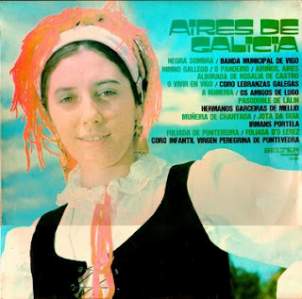
Source: Sempre En Galiza. Música galega. Dixitaliza e comparte
Source: Sempre En Galiza. Música galega. Dixitaliza e comparte
(Cantares Gallegos, 1863)
The Galician Highlands run like an eastern buffer from the Atlantic coast bordering on the Principality of Asturias south to the Portuguese frontier. The better-known mountain ranges of this chain are Os Ancares, O Courel and the Central Ourense Range. Few people dwell in this mountainous region. In De Castro's day they were despised (see poem 9).
Ancares by Luar Na Lubre.
Deep inside O Courel.
"Acolá enriba" contains four affectionate diminutives (feminine termination iña, masculine iño). Usually there is no rigorous one-to-one mapping between this grammatical form and an English word, hence the affectionate diminutive brings an opportunity to add alliteration, internal rhyme and lyrical sharpness to the text while staying true to the context.
All the words in "Acolá enriba" that end in iña or iño are listed below together with a short explanation of the translation made.
meniña morena (1.3). The adjective morena usually means "brown-skinned" but it can also mean "brunette." Since the girl's skin colour is labelled unusually white (6.1) the second definition applies.
na sombra dos pinos (5.9). The literal translation is "pine-trees' shadow." The chosen variation, "evergreens' shadow," reflects the prevalence of an alpine coniferous tree on the Galician Highlands different from the Greek Mediterranean variety cultivated in the rest of the country.
eu lla vestira, eu lla calzara (7.1). Probably inspired by the popular romance, La Pedigüeña (The Exacting Lady).
Galician-Argentinian violinist and composer Andrés Gaos (b. 1874, d. 1959) composed a symphony entitled, "In the Mountains of Galicia," in 1953. Its three movements are presented below.
"Acolá enriba" was published with a line length of six syllables. Here the line length has been doubled to improve readability.
|
Acolá enriba na fresca montaña,
Xa envolta se mira na espuma que salta
Xa erguida na punta de pena sombrisa,
A cofia de liño aos ventos soltada,
Tendida-las puntas do pano de seda,
¡Que feita, que linda, que fresca, que branca
eu lla vestira, eu lla calzara. |
Way up yonder on the cool-clime mountain,
She looks at herself enveloped in leaping spray
She stands erect upon the dark crag's crest,
She unlaces the linen bonnet to the winds;
She raises the tips of the silken shawl;
How comely! How pretty! How natural! How white
I'd ply her with shoes, I'd ply her with dresses. |