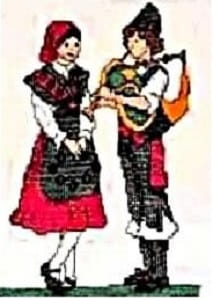
Source: Nuria. Mis bordados a punto de cruz
Source: Nuria. Mis bordados a punto de cruz
(Cantares Gallegos, 1863)
"¿Como me hei de ir si te quero?" is yet another poem that uses the affectionate diminutive form peculiar to the Galician language. The affectionate diminutive ends in iña (singular feminine) or iño (singular masculine) but not every word that ends in iña or iño is an affectionate diminutive.
All the words in "¿Como me hei de ir si te quero?" which end in iña or iño are listed below together with the translation. Galician affectionate diminutives offer the translator an opportunity to add alliteration, internal rhyme and lyrical sharpness to the text. The goal is to find the best adjective, adverb or noun which conveys smallness, frailty, concern or affection depending on the context.
Deses teus olliños negros, / como doas relumbrantes, / hastra as nosas maus unidas / as bágoas ardentes caen (3.1-4). A case of reverse sentence structure whose literal translation is "From your precious dark eyes / Like glittering beads / To our clasped hands / The burning tears fall." Although reverse sentences are a common feature of Spanish poetry they yield ambiguous, crumpled prose in English. The ironed-out translation is often preferable. Three other reverse sentences were reworked (3.9-10, 3.11-12, 8.1-2).
Dearie, sleep yet a while amid the gentle waves of the sea (5.1-2). The couple spent the night on a boat, he is probably a fugitive from justice or a political runaway. Galicia had many political runaways after the failed Liberal uprising of 1846. The posit is buttressed by De Castro's use on line 10.3 of the imperative fuxe, from the verb fuxir (to flee or to run away) whence comes the substantive fuxitivo (fugitive). Nevertheless the word fuxe was prudently translated, "go quickly," to let the reader interpret the poem's circumstances for her/himself.
|
—Cantan os galos pra o día;
—¿Como me hei de ir, queridiña;
—Deses teus olliños negros,
—Meiguiño, meiguiño meigo,
—Aínda dorme, queridiña,
—Xa cantan os paxariños,
—Deixa que canten, Marica;
—Conmigo, meu queridiño,
—Mais en tanto ti dormías,
—Así te quero, meu ben,
—Irei, mais dáme un biquiño
—Con mil amores cho dera,
—Pois confésate, Marica,
—¡Raparigo, Dios te garde! |
"The roosters sing to the dawning day.
"How can I depart, dearie,
"The burning tears fall
"Darling wizard, dear bewitching wizard,
"Dearie, sleep yet a while
"The little birds are already singing,
"Let them sing, Marika;
"You spent half the night
"Yet while you slept
"That's how I want you, my boon,
"I will, but give me a wee kiss
"I would with thousandfold love,
"Go to confession then, Marika,
"God keep you, laddie!" |