Source: Aula del 2º ciclo de Primaria del Colegio Valle Inclán de Ferrol
Source: Aula del 2º ciclo de Primaria del Colegio Valle Inclán de Ferrol
(Cantares Gallegos, 1863)
In the tome "Cantares Gallegos" De Castro often constructs a poem around a popular couplet or quatrain which is quoted in italics. In "Fun un domingo, fun pola tarde" she borrows the leading two lines of the folk song "Pousa" whose first quatrain reads,
|
Fun ó muíño do meu compadre; |
I went to the mill of my child's godfather,1 |
"Fun un domingo, fun pola tarde" makes extensive use of the affectionate diminutive form peculiar to the Galician language. The affectionate diminutive ends in iña (singular feminine) or iño (singular masculine) but not every word that ends in iña or iño is an affectionate diminutive.
All the words in "Fun un domingo, fun pola tarde" which end in iña or iño are listed below together with a range of possible translations and a short explanation of the choice that was made. Galician affectionate diminutives lend the translator an opportunity to add alliteration, internal rhyme and lyrical sharpness to the text. The objective is to find the best adjective, adverb or noun which conveys small size, frailty, concern or endearment depending on the context. This objective ends in a personal choice when more than one translation is available as is often the case. Sometimes an affectionate diminutive is best ignored because the context is unclear, because the extra term jars the smooth flow of the translation or because it makes the text too syrupy. The exercise can be fun, difficult and challenging. The extra work is worthwhile because it offers the English reader an approximation to what De Castro called "those tender words and those idioms never forgotten which sounded so sweet to my ears since the cradle and which were gathered up by my heart as its own heritage."
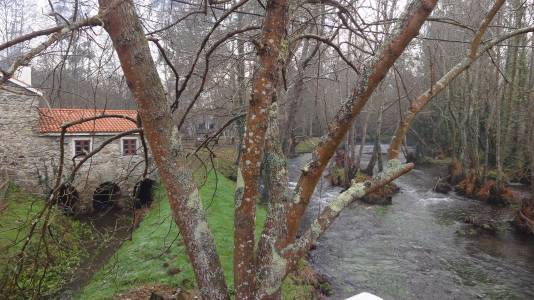
The water mill (muíño) was a place of work and social relaxation and sometimes a venue of consented promiscuity after hours. A gathering of neighbours to grind grain was termed a muiñada. Most mills were built on a wooded river bank (example).
The muíño lent its name to the muiñeira or jig whose lyrics often abound in puns, irony, jokes, jests and jives, a reflection of the jovial atmosphere found at every water mill. For example the third stanza of the muiñeira do Santo Amaro states:
|
Ser solteiro é boa cousa |
Being single is a fine thing |
|
Fun un domingo, fun pola tarde,
Pasín os montes, montes e valles,
Colleume a noite, noite brillante,
Dempois a aurora co seu sembrante
Nela se escoitan doces cantares,
Non hai sitiño que máis me agrade
fun ó muíño do meu compadre; |
I went on a Sunday, I went in the afternoon,
I crossed the hills, hills and valleys,
Nightfall caught up with me, a brilliant night
Afterward the dawn with her semblance
Sweet songs are heard within it,
There is no charming place that pleases me more
I went to the mill of my child's godfather, |