 |
 |
 |
Source: CEIP Pedrouzos (Brión). Xunta de Galicia. Consellería de Educación e Ordenación Universitaria
|
|
|
Source: CEIP Pedrouzos (Brión). Xunta de Galicia. Consellería de Educación e Ordenación Universitaria
(Cantares Gallegos, 1863)
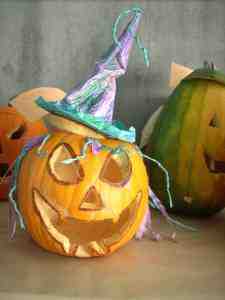
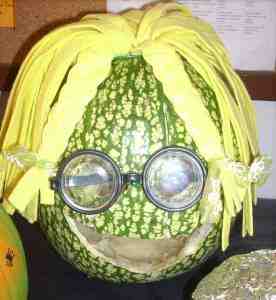
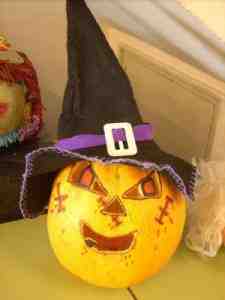
The Galician countryside celebrated the eve of All Hallows by making jack-o'-lantern's out of squashes, melons and pumpkins. They were placed on the margins of country lanes with the playful intention of frightening late-night passersby. The tradition was partly revived in the village of Cedeira in the year 2001 with a contest and display of carved pumpkins in the town's main square. The holiday now termed Samaín forms part of the activities during the month of October in many kindergartens and primary schools of Galicia.
The feast of the pumpkins was closely associated with the harvest festival known as "Magosto" whose star delicacies are roasted chestnuts and grilled corn on the cob. Samaín and Magosto are celebrated jointly in many kindergartens and primary schools of Galicia.
De Castro's bittersweet poem has three interwoven themes. The first is Halloween, which in Galicia went by the name of "feast of the pumpkins" or "feast of the skulls." The protagonist, a naive peasant girl, has just finished carving a jack-o'-lantern and is debating whether to embellish it with her earrings and necklace (see for example min. 1:05-1:12 of this video). She asks the magical pumpkin, the "Dear Saint," to teach her how to stitch, become a seamstress and climb the social ladder. The second theme, spun humorously via the literary device of a talking pumpkin, is the surrounding society's dispiriting cant. The squash sneers and snorts as a neighbour might. The third theme is the girl's resilience, she grows weary of the discouraging talk and brushes the jack-o'-lantern aside.
De Castro agonized over the suffering of the average Galician peasant woman,
And there is so much suffering in this dear Galician land! Whole books could be written about the eternal misfortune that besets our peasants and sailors, the sole true working people of our country. I saw and felt their hardships as though they were my own, but what always moved me, and consequently could not help but find an echo in my poetry, were the countless sorrows borne by our women: loving creatures toward their own folk and toward strangers, full of spirit, as hardy as soft-hearted and also so wretched that one would think they were born only to overcome as many travails as may afflict the weakest and most naive portion of humanity. Sharing the hard, outdoor tasks of farming fifty-fifty with their husbands, braving courageously the anxieties of motherhood indoors, the domestic chores and the wants of poverty. Alone most of the time, having to work from sunrise to sunset, barely able to sustain herself, having without help to take care of her children and perhaps of a sickly father, they seem destined to never find rest but in the grave.Emigration and the King continually take away the lover, the brother, her man—the breadwinner of an often large family—and thus deserted, mourning over their misery, they live out a bitter life amid the uncertainties of hope, the bleakness of solitude and the anxieties of never-ending poverty. And what breaks their heart most is that their men all drift away, some because they are drafted, others because example, necessity, sometimes lust, forgivable though blind, compels them to abandon the dear home of whom they once loved, of the wife become mother and of the many unfortunate children, too small the darlings to suspect the orphanhood they are condemned to.
When these poor martyrs hazard to reveal their secrets confidentially to us, to mourn for their loves always kept alive, to lament over their woes, one discovers in them such delicacy of sentiment, such rich treasures of tenderness, so great a spirit of self-denial that unawares we feel ourselves inferior to those obscure and valiant heroines who live and die performing wonderful deeds forever untold, yet full of miracles of love and unplumbed depths of forgiveness. Stories worthy of being sung by poets better than I and whose holy harmonies ought to be played on one single note and one lone chord, on the chord of the sublime and on the note of pain.
(Prologue to Follas Novas. Santiago de Compostela. March 30, 1880)
"Miña Santiña, miña Santasa" plays with the ambiguous verb "puntear" which can mean to stitch (1.6, 2.6) or to do a sequence of dancing steps (6.6, 11.6).
The poem makes extensive use of the affectionate diminutive form peculiar to the Galician language. The affectionate diminutive ends in iña (singular feminine) or iño (singular masculine) but not every word that ends in iña or iño is an affectionate diminutive.
All the words in "Miña Santiña, miña Santasa" which end in iña or iño are listed below together with a short explanation of the choice made where necessary. Galician affectionate diminutives offer the translator an opportunity to add alliteration, internal rhyme and lyrical sharpness to the text. The aim is to find the best adjective, adverb or noun which conveys smallness, frailty, concern or affection depending on the context.
Miña Santiña, miña Santasa (1.1). The appellatives "my Dear Saint" and "my Great Saint" must be taken playfully.
Cómprelle a seda (3.6). The literal translation is "Silk becomes her"; however this singular form of the pronoun contradicts the grammatical number of its antecedent, "seamstresses," hence it was changed to them.
Falaime solo das muiñeiras (5.3). The muiñeira is a bagpipe melody in triple rhythm similar to the melodies of the Scottish Highlanders.1 Although the reel is the premier melody of the Scottish Highlands it is usually played in duple rhythm with a time signature of 4/4 whereas the jig is played in triple rhythm with a time signature of 6/8.2 Technically therefore the muiñeira resembles a jig more than a reel. In practice the average listener will find it difficult to distinguish between them (test yourself: here are some reels, here are some jigs).
Soul of copper—choker of silver—youth laughing—old age weeping (8.2-3). The jack-o'-lantern speaking like a witch proposes a riddle to the reader. So what had the soul of copper, a choker of silver and prompted the young to laugh, the old to weep? In the context of the jack-o'-lantern's banter the answer to the riddle is most likely the daguerreotype (France, 1839). Thus the pumpkin is asking for a photograph of the seamstress conversing with a dude.
Romería (9.2, 10.8). Traditionally a festive outing and picnic in the land close to a chapel or monastery on the holiday of its namesake.
Witch's eyes—monkey face— (11.2). Evil eyes, grinning face: a jack-o'-lantern.
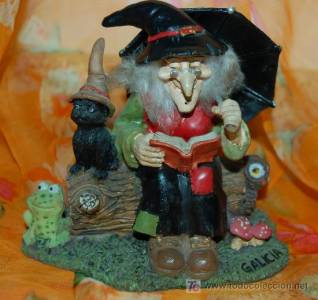
The entire atmosphere of "Miña Santiña, miña Santasa" is the magical world of the Galician countryside. The poem mentions a respected, sometimes feared, figure of that world, the meiga (11.2): witch or sorceress. She is on occasion beautiful, desirable and benevolent, esteemed for her knowledge of herbal remedies, psychology and magical powers of healing, but she can also be ugly, fearsome and evil, respected and feared for her curses and for her ability to cast spells. A popular Galician saw cautions skeptics, "I don't believe in witches myself, but exist they do."
Source: Todo Colección
The only Galician woman tried for sorcery was a wealthy widow of the seaside town Cangas do Morrazo. Her name was Maria Soliña and the year was 1621. Today her conviction is seen as a frame-up by the Spanish Inquisition and by unscrupulous local officials eager to seize her wealth and properties.
The witch has broadly speaking become a lovable myth across Galicia, and so the wistful waltz "A Bruxa" (The Witch) recorded first by Milladoiro and covered below by the Argentinian Celtic folk group Xeito Novo and by the North American An Dro.
"Miña Santiña" was published originally with a line length of five syllables. While this staccato format suits a very brief poem its use in longer poems annoys. Accordingly the original poem has been compressed here to half the usual number of lines and the line length expanded to ten syllables.
Boldface annotation added to assist the reader's comprehension identifies the speaker.
Since the Middle Ages, perhaps from earlier times, the Galician farmer kept the yield of his farm in an outdoor storehouse raised off the ground to keep mice at bay. The granary or hórreo stood on a granite platform supported by two parallel rows of capped stone pillars or it rested on the staddle stones; a farmer employed a ladder to go inside it. These sheds on stilts usually have a standing cross at each end of the roof ridge which gives them the air of a shrine. Pumpkins were usually left outside the granary on a shelf, on a staddle stone or hung from a wall and so the jack-o'-lantern of "Miña Santiña, miña Santasa" would in the girl's imagination bear a resemblance to the figure of a saint in a wall shrine common inside the churches and chapels of her day.
|
—Miña Santiña, miña Santasa,
—Costureiriña comprimenteira,
—Miña Santiña, mal me quixere
—¡Ai rapaciña! Tí te-lo teo:
—Santa, Santasa, non sos comprida,
—Costureiriña do carballal,
—Miña Santasa, miña santiña,
—¡Costureiriña que a majos trata!
—Deixade as herbas, que o que eu quería
—¡Ai da meniña! ¡Ai da que chora!
—¡Ai, que Santasa! ¡Ai, que Santona! |
Girl: My Dear Saint, my Great Saint,
Pumpkin: Dear obsequious seamstress,
Girl: My Dear Saint, such advice would come
Pumpkin: My dear girl! You have gid:
Girl: Saint, Great Saint, you are not genteel,
Pumpkin: Dear seamstress of the oak forest,
Girl: My Great Saint, my dear saint,
Pumpkin: Poor seamstress who talks to dudes!
Girl: Forget the pasture, what I wanted was
Pumpkin: Woe to the child! Woe to the one
Girl: Ah, what Great Saint! Ah, what |