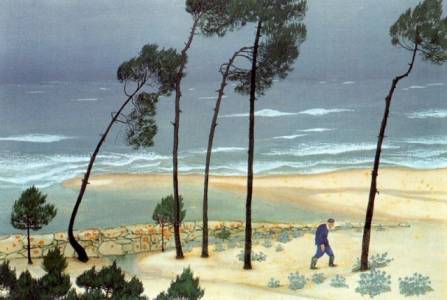
Vento Mareiro. Alfonso Daniel Rodríguez Castelao.
All Paintings Home
Vento Mareiro. Alfonso Daniel Rodríguez Castelao.
All Paintings Home
(Cantares Gallegos, 1863)
The noun "homeland" is genderless in English, but not in Galician: "miña terra" is a feminine pair. Every occurrence of the feminine pronoun in "Airiños, airiños aires" refers to the writer's homeland, not to a person, so it can also be translated as "my homeland" or "home" (1.4, 16.12).
The poems of "Cantares Gallegos" abound in the use of the affectionate diminutive peculiar to the Galician language. "Airiños, airiños aires" employs sixteen. The affectionate diminutive of a word ending in "a" is iña (feminine case) and the affectionate diminutive of a word ending in "o" is iño (masculine case). The plural variance is iñas and iños. Affectionate diminutives make the exercise of translating harder and something of artwork, but to ignore them altogether is to miss the full emotivity of the poem. On the plus side Galician affectionate diminutives afford the translator an opportunity to add alliteration, internal rhyme or lyrical sharpness to the text as part of the exercise of finding the best modifier which conveys size, frailty, sympathy or endearment depending on the context.
All the words in "Airiños, airiños aires" whose singular form ends in iña or iño are listed below together with a range of possible translations and a short explanation of the choice made where useful. Please note that not every word that ends in iña or iño is an affectionate diminutive.

Source: Fátima Grandal Rodríguez
Bloodsucking witch (6.5). In Galician folklore a witch that enters a house at night to suck the blood of a sleeping child. This short film relates the legend of this witch. It is interesting to note that the tale has two meigas, one good, one bad. The good one (a "wise woman" who dwells on the far side of the woods) saves the last surviving child with her advice (min. 3:47-4:40).
Vaca vermella (10.2). Literally "red cow," a term used by dairy farmers, but a better approximation to the cow-coat's colour for a city dweller is, "golden-red."
Pombas que arrulás nas eiras (10.4). The word "arrulás" discloses that these pigeons are turtle doves (Galician: rulas).
Mozos que atruxás bailando (10.5). "Atruxar" is the blend of a yodel and a prolonged yell. Examples: Minutes 0:04-0:11, 1:48-1:52 and 3:10-3:15 of this video.
¡Muiñeira, muiñeira! (10.12). The muiñeira is a bagpipe melody in triple rhythm similar to the melodies of the Scottish Highlanders.1 Although the reel is the premier melody of the Scottish Highlands it is usually played in duple rhythm with a time signature of 4/4 whereas the jig is played in triple rhythm with a time signature of 6/8.2 Technically therefore the muiñeira resembles a jig more than a reel. In practice the average listener will find it difficult to distinguish between them (test yourself: here are some reels, here are some jigs). Some traditional muiñeiras are: Muiñeira de Chantada, Muiñeira de Lugo and Muiñeira de Pontesampaio.
Among the white skulls (16.8). An ossuary exposed to the air.
Xas-co-rras-chás (10.7). Sound of two seashells being rubbed together, delivered approximately by "shas-caw-russ-chas" in the translation. A more accurate rendition with the Oxford Pronunciation Guide for English Dictionary is /ʃɑs:/ /ko:/ /rɑs:/ /tʃɑs:/
Xurre-xurre (10.8). Sound of the tambourine (example) delivered approximately by "shur-ray shur-ray" in the translation or by /ʃure:/ /ʃure:/
Run-run (14.8). Droning sound of the wind approximated by "roon-roon."
Pop star of the seventies and eighties Víctor Manuel covered the song on Galician TV in 2008,
Gustavo Freire the composer of at least eight notable Galician pieces published this rhapsody entitled, "Airiños Aires," in the year 1930,
Banda de Música "Ciudad de Plasencia"
|
Airiños, airiños aires,
Sin ela vivir non podo,
Cróbeme unha espesa nube
Levaime, levaime, airiños,
¡Ai!, si non me levás pronto,
Fun noutro tempo encarnada
Voume quedando muchiña
Levaime, levaime, airiños,
Si pronto non me levades,
¡Ai, miña probe casiña!
¡Ai, quen fora paxariño
Agora mesmo partira,
Pero non son paxariño
Doces galleguiños aires,
Non permitás que aquí morra,
Aínda penso, airiños aires, |
Breezes, sweet airy winds,
Without her I can not live,
Over me hovers a thick cloud
Carry me away, breezes, carry me,
Aye! If you don't carry me away soon,
I was upon another time carmine
I am withering away alas!
Carry me away, breezes, carry me,
If you don't carry me away soon
Ah, my poor dear house!
Ah, who were a little bird
This very instant I'd part,
But I am not a small bird
Sweet Galician winds that I love,
Do not let me die here,
I even think, sweet airy winds, |